Saturday, March 17, 2012
installation in progress
Wednesday, March 14, 2012
moving in, setting up new installation space
| moving in, wall boards up 3/11 |
| 3/12 & 13, wall board painted, start to move over work |
| 3/14, start installing |
| more views |
| try adding in ceramic swan & duck |
Saturday, March 10, 2012
new work, better images
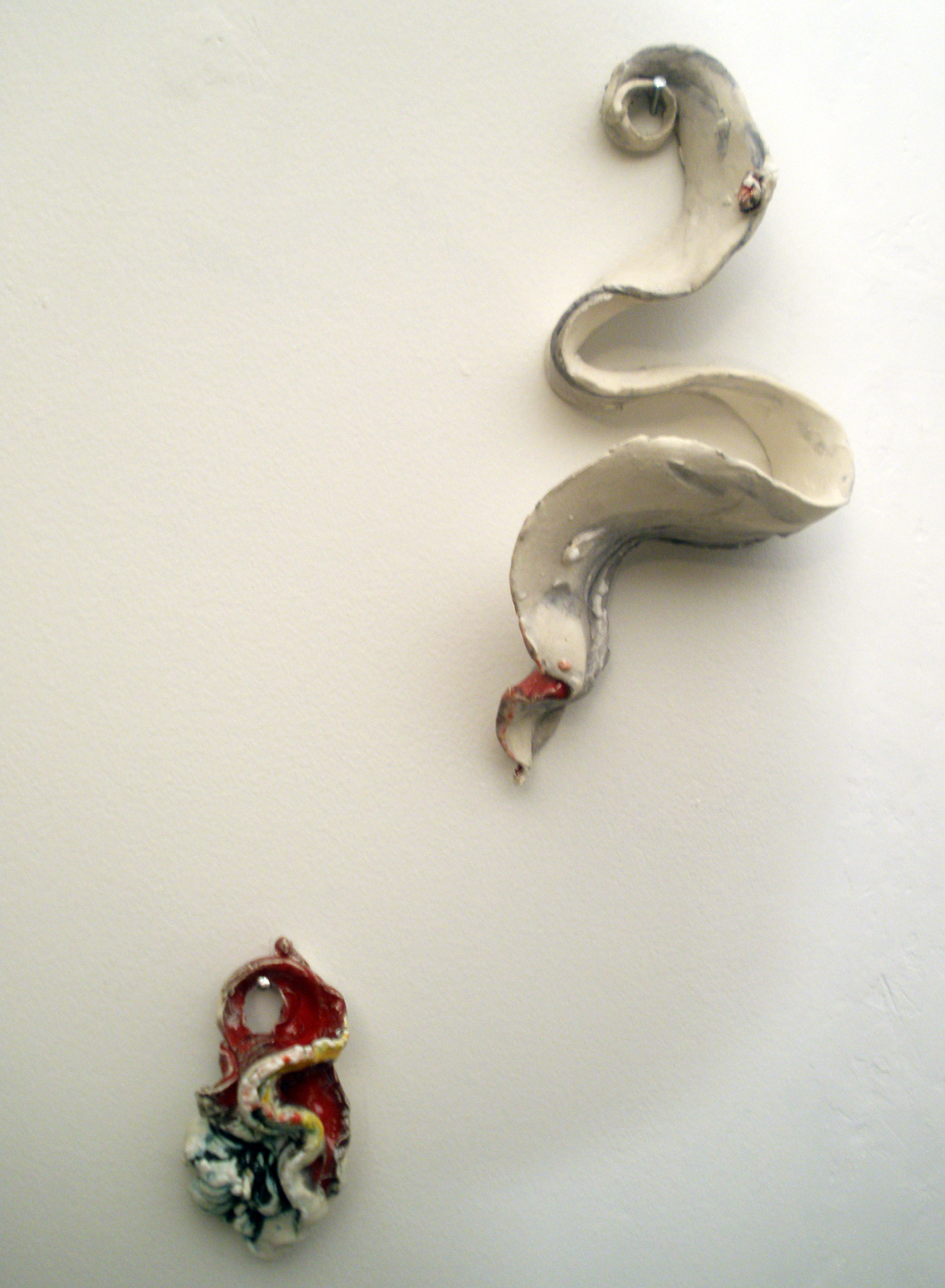
Now that the pieces I've created since Jan. are finally through the firing process, I'll be moving them over to my installation space to see how they interact. Several have been in and out of the kiln numerous times to get the layers of color and surface textures. With the exception of the group of small "flames", these are wall pieces. The orbs are 13" to 15" diameter with piano wire extensions up to 27"h.
| ceramic with piano wire |
| detail |
| detail |
| ceramic with piano wire and astro-turf |
| another view |
| better image of orb from previous post |
| detail |
| misc. flames for installation |
| another view |
Thursday, March 1, 2012
work on its way
![]() |
| green orb with piano wires |
| broken mound, in kiln before glaze firing |
| concentric circle mound, in kiln for glaze firing |
| spiral mound, in kiln for glaze firing |
| greenware |
| As above, 1st glaze firing, side view |
| another view |
| greenware |
| As above, 1st glaze firing |
| finished work |
| refired from first set of squashed pots |
Jim and I have been discussing the use of circles/mounds with the implication that they read as portals and/or eruption. A black circle indicates a hole when placed on the ground, or wall for that matter. I'd like the mounds to appear to rise up from the earth. The spiral mound will have both piano wires and astro-turf. The glaze before firing doesn't represent the true colors. The pink and blue center squashed pots will be refired at a high temperature. The white matt glaze is too flat, the black should have appeared like gun metal, and the pink is uneven. If I fire the red glazed pots higher to improve the white matt, I'll loose the red glaze. These pots will become part of my experiment to project words. I envision them on (clean) black circles, not wheel bats as photographed. Once this group of works is complete, I need to focus on my installation space and just play with the forms and how they are perceived in their environment. I've got a mini projector but still need to figure out how to use it!
Jim also asked me to do drawings of some of the forms I made last semester. My first attempts are quite academic; it wasn't not easy at that. Maybe next I'll enlarge and focus on one part. Not sure what the direction is here.
Saturday, February 11, 2012
Today Jim Melchert visited my studio and we spent three hours discussing art in general and my work. He suggested I spend some time with a piece to absorb its energy, and draw it. We talked about how I have the propensity to go over the top with the amount of information packed into a piece. When I spoke about my interest in having the space of the art extend into the wall or through the floor, he suggested I explore ways to make that more visible. (Make a model with tennis ball...) He also recommended I try working big with other materials, although I really don't have the desire to have large forms. I hope to be playing with the work in a new space soon.
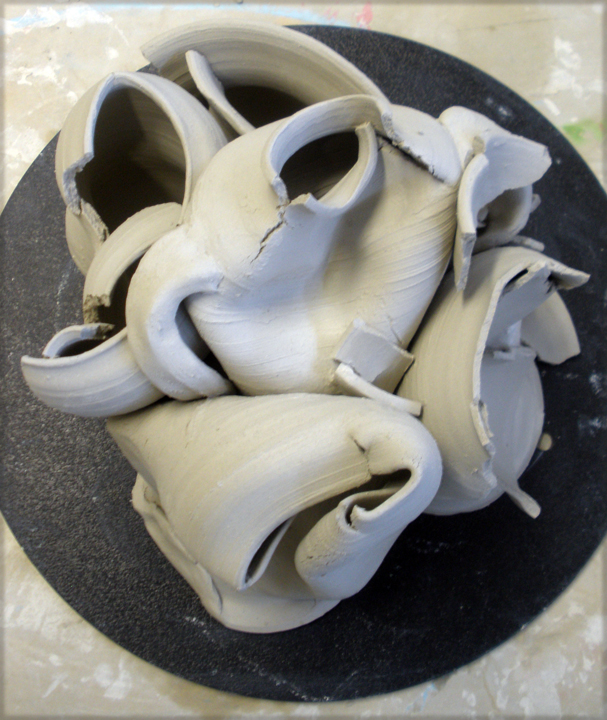
Jim mentioned that you won't find a straight line in my work. That is an astute point to ponder. Am aI afraid straight is static? In general, I consciously play off curves and swaying motion of the form to infer dance, flow, and music. I like that he noted a feeling of rubber, elasticity, bouncing back, and resilience. Jim saw Morandi, not so much Ohr or Chamberlain in the new work and thought perhaps I was being flippant or a feeling of oppression? It is true that Chamberlain's work infers the power and inherent danger in flattening those car bodies and scale is important to their presence. Jim isn't recommending that I continue with the squashed pots although I feel like I haven't taken them far enough. What I learned in the process was that the forms read better without glaze. Glazing them has presented several problems. Because of all of the trapped areas, it would be better to dunk them as one would a single pot. Brushing on the glaze lead to uneven areas. The glaze choices were not great either, especially the brown on the broken pots. The blue under glaze helped, but still yuk. They look best from the top, not from the side. I may throw a few more with red clay and some with white, all unglazed.
Thursday, I drove to Cal State Stanislaus to see an excellent exhibit by last semester's mentor, Robert Ortbal. It was great to hear him discuss his process and ideas behind the work. It was either hung or placed on the floor. No pedestals, no labels, very clean. It made me engage with the light, shadows, and materials, all perfectly synched.
Jim mentioned that you won't find a straight line in my work. That is an astute point to ponder. Am aI afraid straight is static? In general, I consciously play off curves and swaying motion of the form to infer dance, flow, and music. I like that he noted a feeling of rubber, elasticity, bouncing back, and resilience. Jim saw Morandi, not so much Ohr or Chamberlain in the new work and thought perhaps I was being flippant or a feeling of oppression? It is true that Chamberlain's work infers the power and inherent danger in flattening those car bodies and scale is important to their presence. Jim isn't recommending that I continue with the squashed pots although I feel like I haven't taken them far enough. What I learned in the process was that the forms read better without glaze. Glazing them has presented several problems. Because of all of the trapped areas, it would be better to dunk them as one would a single pot. Brushing on the glaze lead to uneven areas. The glaze choices were not great either, especially the brown on the broken pots. The blue under glaze helped, but still yuk. They look best from the top, not from the side. I may throw a few more with red clay and some with white, all unglazed.
Thursday, I drove to Cal State Stanislaus to see an excellent exhibit by last semester's mentor, Robert Ortbal. It was great to hear him discuss his process and ideas behind the work. It was either hung or placed on the floor. No pedestals, no labels, very clean. It made me engage with the light, shadows, and materials, all perfectly synched.
Sunday, February 5, 2012
2nd semester: new beginnings
On the way down to SF to see Annabeth Rosen's ceramic sculpture exhibition at Paule Anglim Gallery and the Stephen De Stabler totemic figure show at the De Young Museum, I passed a semi truck loaded with compressed car bodies, a sight that has always seemed hauntingly beautiful and frightening. Naturally it made me think of John Chamberlain's work but also my own run over cups and George Ohr. Upon return, I embarked upon a new series of squashed and compressed vessels. They are like the writhing bodies in Dante's inferno. It has been years since I've thrown so it is a struggle! I don't feel compelled to make them ideal forms which helps. Bodies are not perfect and come in all shapes and sizes. The first three pieces are in the kiln for bisque. The glazing will probably be monochromatic. I expect to try some with underglaze color before squashing them. The third piece was beyond leather hard so the vessels cracked as well as slumped when compressed.
I also have a floor based mound in the works. I drove out to my piano tuner's shop and picked up some old piano strings to extend ceramic pieces off of the mound. I am hoping they will add sway and movement.
My first meeting with mentor Jim Melchert is scheduled for next weekend. He has graciously offered to come to my studio to get an overview of work produced for the program and discuss goals for the semester.
I also have a floor based mound in the works. I drove out to my piano tuner's shop and picked up some old piano strings to extend ceramic pieces off of the mound. I am hoping they will add sway and movement.
My first meeting with mentor Jim Melchert is scheduled for next weekend. He has graciously offered to come to my studio to get an overview of work produced for the program and discuss goals for the semester.
| squash pots 1a. |
| squash pots 1b. |
| squash pots 2a. |
| squash pots 2b. |
| squash pots 3a. |
| squash pots 3b. |
| squash pots 3c. |
| squash pots 3d. |
Subscribe to:
Posts (Atom)